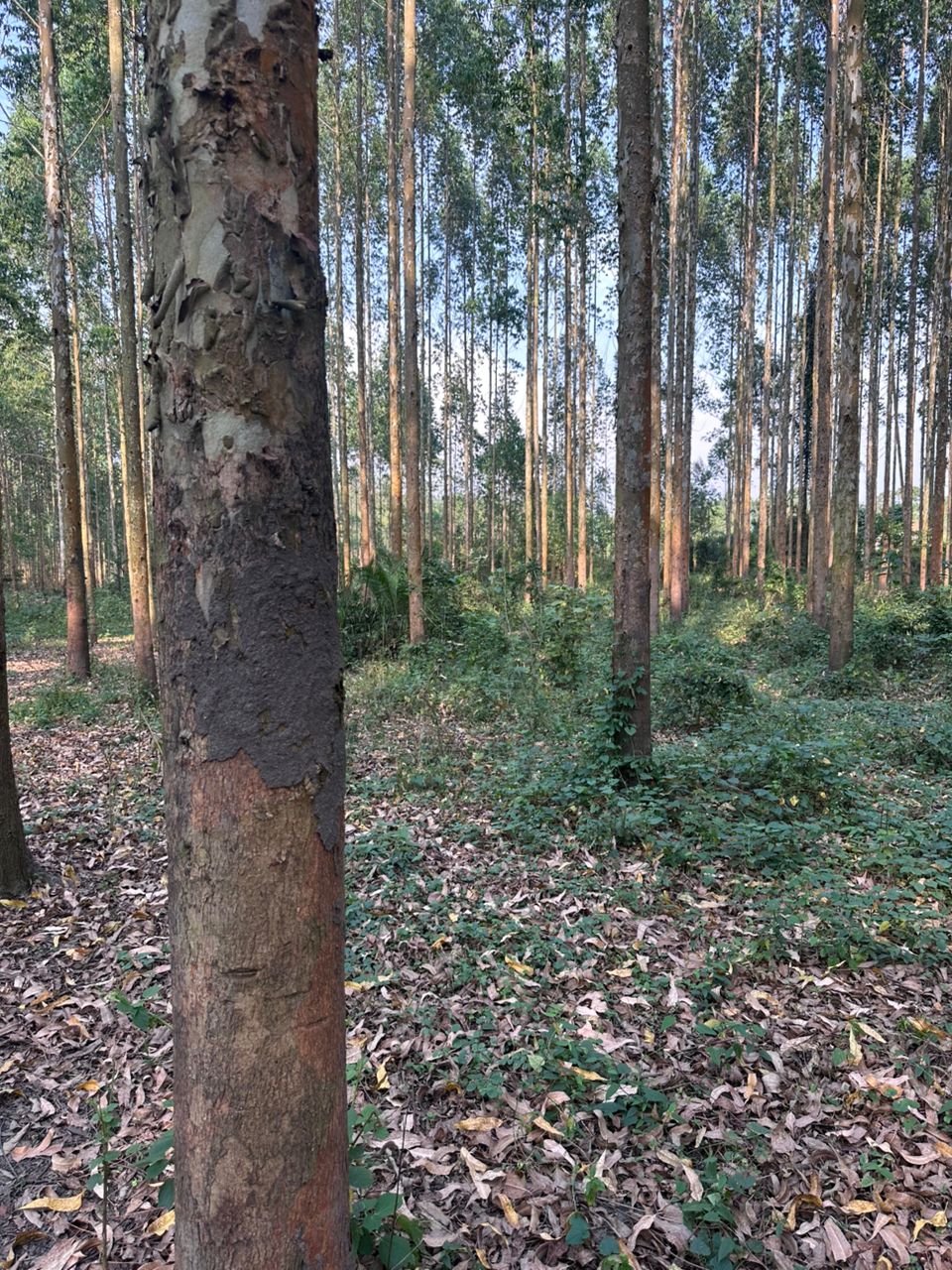
Why This Region Became the Plantation Belt
Three things converged, and they still hold:
- Land in commercial blocks. Unlike the fragmented smallholdings of the Lake Victoria crescent, this region has land available at a scale that justifies machinery, permanent staff and proper management.
- Soils and rainfall that work. Reliable rainfall across most of the belt, with deep soils in Bunyoro in particular.
- The SPGS era. The Sawlog Production Grant Scheme drove a wave of private plantation establishment here from the mid-2000s, and much of the country's maturing commercial timber is a result. See planted forests of Uganda.
The consequence today is a region with maturing plantations changing hands, sawmilling capacity growing, and a functioning market for standing timber. Which is exactly the environment in which independent technical advice earns its fee.
Conditions Across the Belt
| Area | Character | Species that suit |
|---|---|---|
| Mubende, Mityana | Mid-altitude, bimodal rainfall, mixed soils from good loams to lighter ridges | Eucalyptus (grandis, GU); pine on poorer ground |
| Kiboga, Kyankwanzi | Drier toward the cattle corridor; lighter soils in places | Pine; E. camaldulensis or GC on drier ridges |
| Masindi, Kikuube | Bunyoro's deeper soils, good rainfall, established timber processing nearby | Eucalyptus, pine, teak on suitable ground |
| Hoima, Kibaale | Good soils, growing commercial activity, improving road access | Eucalyptus, pine, musizi on the better ground |
The important local judgement across this belt is the eucalyptus-versus-pine decision, and it is genuinely site-by-site. Soils vary sharply between valley loams and thin, acidic ridge ground within a single property. Pine will produce a crop where eucalyptus will not; eucalyptus pays back in a third of the time where the ground supports it. Getting this wrong across 200 hectares is expensive in a way that getting it wrong on two acres is not — see soil requirements.
Technical Due Diligence on Plantation Acquisitions
This is now a large part of what we do in the belt, because SPGS-era plantations are changing hands and buyers are frequently pricing on the seller's description.
What a buyer should establish before paying
- Measured standing volume by species, grade and compartment — not "approximately 300 hectares of mature pine".
- Actual planted area versus title area. These diverge more often than sellers expect, once firebreaks, roads, wetland exclusions and failed compartments are deducted.
- Age and management history per compartment. A block thinned on time and one never thinned look similar from the road and are worth very different sums.
- Tenure, and whether it is title or licence. A licence over reserve land is a lease with an expiry date, not an owned asset. Investors conflate the two and it shows up sharply at exit.
- Encroachment and boundary status, verified on the ground and against imagery.
- Fire history. Satellite imagery reveals burns that nobody volunteers.
- Access and extraction feasibility in the wet season, which materially affects realisable value.
We deliver this as a written report with maps, compartment tables and a risk register — the document a buyer can put in front of a lender or an investment committee.
Inventory and Valuation at Block Scale
Systematic inventory is the core technical service here. Plot layout designed for the required precision, calibrated measurement of diameter and height, volume calculated by grade, and results reported by compartment with the methodology stated so it can be independently checked.
Growers in this region are selling into a market with real buyers and real competition, and the difference between a measured and an unmeasured sale is large in absolute terms at block scale. See tree buyers and tree prices.
The Thinning Problem
The most common technical failure we find in the belt is pine blocks that were never thinned. The first thinning often produces material with little market value, so it feels like paying to destroy your own trees — and it gets deferred, then skipped.
The result at year fifteen is a stand of uniformly thin stems, none of which reach sawlog dimensions: a fifteen-year investment yielding low-grade material. It is entirely preventable and entirely unrecoverable once it has happened. Full detail in pine spacing and thinning.
If you hold a pine block approaching or past the first thinning window, that is the assessment to commission before anything else.
Compliance at Scale
Block-scale forestry attracts obligations that a smallholding does not:
- Environmental assessment may be required for larger establishment schemes — see ESIA consultancy.
- Wetland and riverbank exclusions must be mapped and respected across a large property, not eyeballed.
- Lender and buyer requirements increasingly include environmental and social performance evidence — see ESG consultancy.
- Traceability and land-cover history for deforestation-free claims and carbon eligibility — see timber export and carbon eligibility.
How We Work Upcountry
We batch visits by region, so lead time for the belt is typically two to three weeks. For a substantial assignment we mobilise a field team and work continuously rather than making repeat trips — it is faster and it costs you less.
Everything is quoted as a fixed fee against a written scope, with deliverables and timeline stated. If your decision is time-critical — an acquisition deadline, a buyer's offer expiring — tell us and we will prioritise.