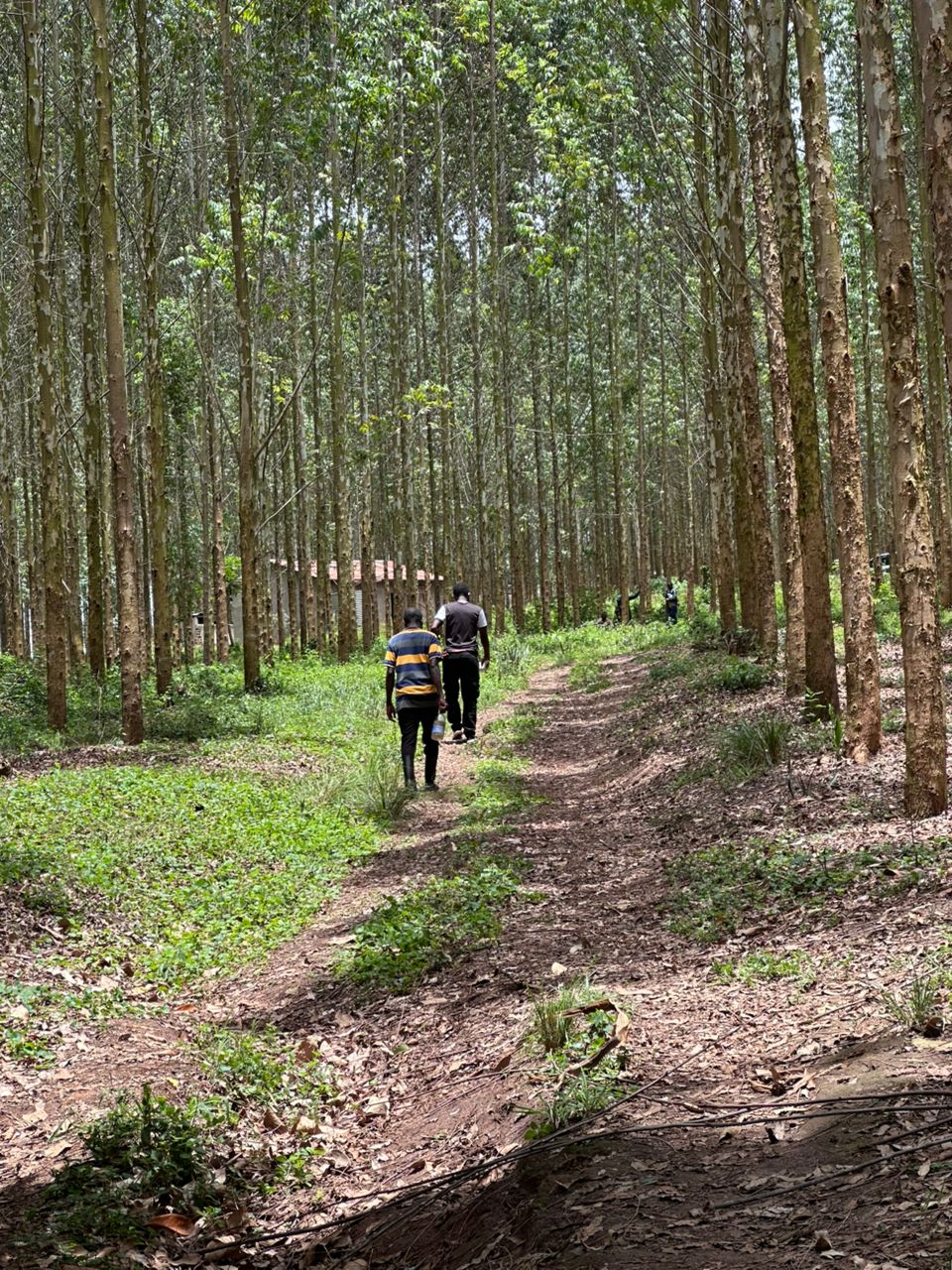
Teak Plantations in Uganda: Where It Works and What It Returns
Teak (Tectona grandis) is an introduced species that grows well in the parts of Uganda with a pronounced dry season — principally West Nile (Arua, Nebbi, Zombo, Koboko) and parts of Bunyoro and the north.
It needs deep, free-draining, fertile soil and will not tolerate waterlogging or acidic, shallow ground. Rotation is long: 20–25 years or more for quality sawn timber, with thinnings along the way.
The attraction is value. Teak is one of the world's premium timbers with genuine international demand. The catch is that it is unforgiving about site and you find out slowly.
Free tool — no sign-up Model a 20-year teak rotation Long rotations hide their costs. Put yours in and see the annualised number.
Teak comes up whenever a Ugandan landowner starts researching high-value timber. The honest position is that it is an excellent crop on the right ground and a slow, expensive disappointment on the wrong ground — and the ground is more decisive for teak than for almost any other species planted in Uganda.
Where Teak Works in Uganda
Teak evolved in monsoon forest — a wet season followed by a genuinely dry one. That seasonality is not incidental; it drives the growth rhythm and the timber quality. Which is why teak in Uganda concentrates where rainfall is unimodal rather than bimodal.
| Region | Districts | Suitability |
|---|---|---|
| West Nile | Arua, Nebbi, Zombo, Koboko, Maracha | Best in Uganda. Unimodal rainfall, pronounced dry season, suitable soils. Teak has been grown here for decades. |
| Northern | Gulu, Amuru, Adjumani, Lira | Good where soils are deep and free-draining. Fire risk is the main constraint. |
| Bunyoro | Masindi, Kikuube, Hoima | Workable on the right soils; more rainfall and less pronounced dry season than West Nile. |
| Central | Wakiso, Mukono, Mubende | Marginal. Bimodal rainfall without a strong dry season. Eucalyptus and musizi are better choices here. |
| South-west highlands | Kabale, Kisoro | Unsuitable — too cool and too high. |
What Teak Demands From a Site
- Deep soil. A metre or more of rootable depth. Teak on shallow soil over hardpan stays small and forks badly.
- Free drainage — non-negotiable. Teak dies in waterlogged ground. Valley bottoms and seasonally flooded flats are out.
- Near-neutral to slightly alkaline soil. Teak dislikes strongly acidic soils, which is the opposite of pine and a common reason it fails on land where pine would thrive.
- Fertility, especially calcium. Teak is a demanding feeder and responds visibly to good ground.
- Full light. A strong light-demander; it will not develop under shade.
- A real dry season. Deciduous behaviour — teak drops its leaves — is part of how the timber develops.
The soil test that saves twenty years
- Dig a pit at least a metre deep in several places across the block, at the start.
- You are looking for depth, absence of hardpan or laterite, absence of mottling or grey horizons that indicate waterlogging, and soil pH.
- If the site is acidic and shallow, plant pine. If it is waterlogged, plant nothing there.
- A soil assessment costs a fraction of a teak establishment budget and is the difference between a crop and a twenty-year mistake.
One day of soil pits now beats twenty years of hoping.
Spacing, Thinning and Pruning
| Stage | Typical timing | What happens | Stems per acre |
|---|---|---|---|
| Establishment | Year 0 | Plant at 2.5m × 2.5m or 3m × 3m | 450–650 |
| First thinning | Years 5–8 | Remove the poorest and most forked; usually low value | ~250–350 |
| Second thinning | Years 10–14 | Material becomes saleable as small poles and posts | ~150–200 |
| Third thinning | Years 15–18 | Saleable timber | ~100–140 |
| Final harvest | Years 20–25+ | Sawlogs at premium grade | ~100–140 |
Timings are indicative and shift with site quality. Get a site-specific prescription rather than following a generic schedule.
Pruning matters more for teak than for almost any other species you can plant in Uganda. The value is concentrated in clear, knot-free bole length. Teak that is never pruned produces knotty timber that sells at a fraction of clean-stem prices, and pruning cannot be done retrospectively — the knots are already inside the tree. Prune progressively from early on, taking lower branches in stages rather than all at once.
Rotation and Returns
Teak is a twenty-year-plus proposition to premium sawlog. Three practical consequences:
- Tenure security dominates. Over twenty-five years, clarity of title matters more than soil quality. Customary land arrangements that are workable for a seven-year eucalyptus rotation are a serious risk over a teak rotation. Resolve tenure completely before planting.
- Thinnings carry the middle years. From the second thinning onward, material has value. This matters for cash flow and should be in the model from the start.
- Fire protection for two decades. Mature teak is relatively fire-resistant, but young teak is not, and northern Uganda's dry seasons are long. Maintained firebreaks every year, without exception.
Teak does coppice, which gives some options at the end of a rotation, though managed replanting is generally the better route for quality timber.
Five Ways Teak Blocks Go Wrong
- Planted on acidic, shallow or waterlogged ground because the land was cheap. The commonest failure by a wide margin, and unrecoverable.
- Never pruned. Produces knotty timber worth a fraction of clean-stem teak. Cannot be fixed later.
- Never thinned. A stand of uniformly thin stems, none of which reach sawlog grade — the same failure as unthinned pine.
- Lost to fire in year six. Six years of investment, gone in an afternoon, because firebreaks were not maintained.
- Tenure unravels at year fifteen. The most painful of all, because the crop was fine.
Teak or Something Else?
| Teak | Eucalyptus | Pine | |
|---|---|---|---|
| Rotation | 20–25+ years | 5–8 years | 15–20 years |
| Soil pH preference | Neutral to alkaline | Slightly acidic to neutral | Tolerates acidic |
| Waterlogging | Fatal | Poor | Poor |
| Best Uganda region | West Nile, north | Central, everywhere | Highlands, poorer soils |
| Timber value | Premium, international demand | Modest, local | Middle, local and regional |
| Pruning critical? | Yes — decisive | Minor | Helpful |
| Coppices? | Yes | Yes — 2–3 rotations | No |
Our practical advice: if you are in West Nile or northern Uganda with deep, free-draining, non-acidic soil and secure long-term tenure, teak is one of the strongest land-use options available to you. If any one of those four conditions is missing, plant something else. See forest investment returns and model it with the investment calculator.
Frequently Asked Questions
Does teak grow well in Uganda?
Yes, in the right places. Teak does well where there is a pronounced dry season — principally West Nile (Arua, Nebbi, Zombo, Koboko), parts of northern Uganda, and workable areas of Bunyoro.
It is marginal in the bimodal-rainfall central region and unsuitable in the cool south-western highlands. Site is more decisive for teak than for almost any other species planted in Uganda.
How long does teak take to mature in Uganda?
Twenty to twenty-five years or more for premium sawn timber, with thinnings producing saleable material from roughly the second thinning at years ten to fourteen.
Over that horizon, tenure security matters more than soil quality. Resolve title completely before planting — customary arrangements that work for a seven-year eucalyptus rotation are a serious risk over a teak rotation.
What soil does teak need?
Deep (a metre or more of rootable depth), free-draining, fertile, and near-neutral to slightly alkaline. Teak dislikes strongly acidic soils — the opposite of pine.
Waterlogging is fatal. Dig soil pits across the block before committing: you are looking for depth, absence of hardpan, absence of mottling or grey horizons indicating waterlogging, and pH. If the site is acidic and shallow, plant pine instead.
Do I need to prune teak?
Yes, and it matters more for teak than for almost anything else you can plant in Uganda. Value is concentrated in clear, knot-free bole length, and unpruned teak produces knotty timber worth a fraction of clean-stem prices.
It cannot be done retrospectively — the knots are already inside the tree. Prune progressively from early on, taking lower branches in stages.
Is teak the same as muvule?
No, and the confusion is common because muvule (Milicia excelsa) is sometimes marketed in English as "African teak". They are entirely different trees.
Teak is Tectona grandis, an introduced species with no traditional Luganda name. Muvule is indigenous and is one of Uganda's most valuable native hardwoods.
How much is teak worth?
Teak is one of the world's premium timbers with genuine international demand, and it commands prices well above eucalyptus or pine per cubic metre.
But value depends heavily on grade — clear, well-grown, properly pruned stems of adequate diameter are worth many times knotty or undersized material. Note also that Uganda has at times restricted or banned the export of unprocessed logs; confirm the current position before planning around export. See our timber export guide.
Is Your Site Teak Country?
Teak is unforgiving about drainage and needs a real dry season. We will tell you honestly whether your land suits it before you spend twenty years finding out.
Over a decade establishing, measuring and managing eucalyptus, pine and indigenous plantations across Uganda. Based in Wakiso, Kampala. Reviewed and updated August 13, 2026.