How Much CO₂ Does a Tree Absorb? An Honest Answer
There is no single figure, and the widely-quoted ones are close to meaningless. Carbon stored depends on species, wood density, age, size, site and stocking — and it varies by an order of magnitude across those.
What is reliable is the method: volume × wood density × expansion factors × 0.47 × 44/12. Put your own numbers in and you get a defensible estimate. Take a number off a poster and you get a slogan.
Why There Is No Single Number
You will see figures like "a tree absorbs 22 kg of CO₂ a year". Consider what that has to average over:
- Species. Wood density ranges from about 0.3 to over 0.8 t/m³. A dense hardwood stores more than twice the carbon of a light softwood at the same volume.
- Age. A one-year-old seedling stores almost nothing. A mature tree stores hundreds of kilograms. The rate also changes: fastest in the middle of the rotation, slower at both ends.
- Site. The same species on good ground versus poor ground can differ threefold in growth.
- Stocking. Per tree figures fall as stocking rises, even while per hectare figures climb.
A single per-tree number collapses all of that into an average of things that are not comparable. Per hectare, with stated assumptions, is the only useful unit.
The Actual Calculation
| Step | Calculation | Typical values |
|---|---|---|
| 1. Stem biomass | Volume (m³) × wood density (t/m³) | Density 0.35–0.75 |
| 2. Above-ground biomass | × biomass expansion factor (branches, bark, leaves) | BEF 1.15–1.6 |
| 3. Below-ground biomass | Above-ground × root-to-shoot ratio | 0.20–0.30 |
| 4. Total biomass | Above + below | — |
| 5. Carbon | × carbon fraction | 0.47 (IPCC default) |
| 6. CO₂ equivalent | × 44/12 | = × 3.667 |
Why 44/12? Carbon has an atomic mass of 12; carbon dioxide has a molecular mass of 44. One tonne of carbon locked in wood corresponds to 3.667 tonnes of CO₂ removed from the atmosphere.
What a Hectare Holds
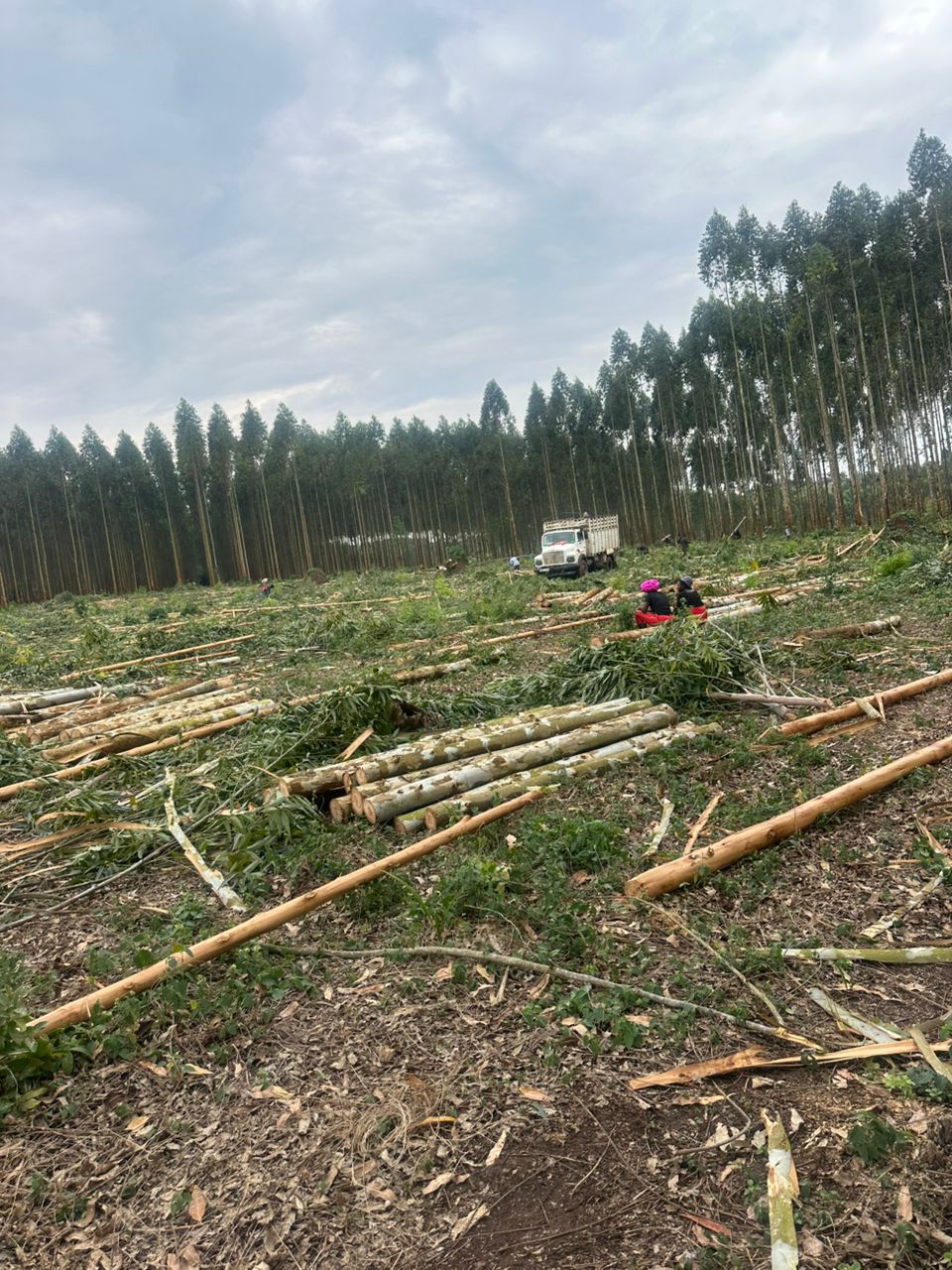
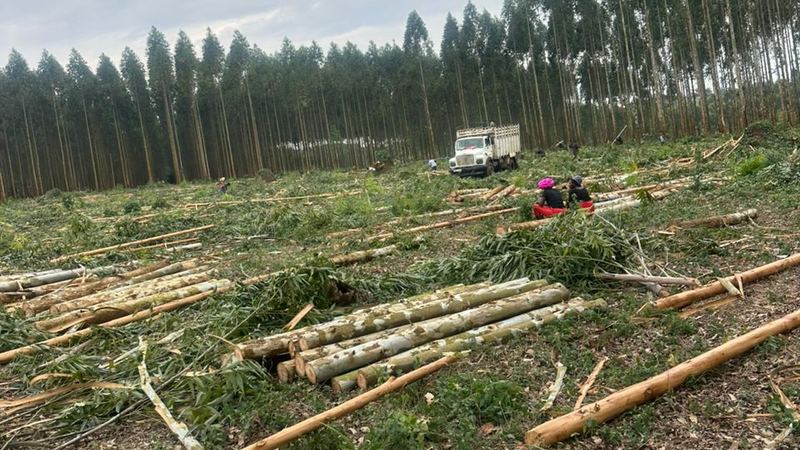
Worked example. A plantation with 150 m³/ha standing volume, wood density 0.55, BEF 1.3, root-to-shoot 0.25, carbon fraction 0.47:
- Stem biomass: 150 × 0.55 = 82.5 t/ha
- Above-ground: 82.5 × 1.3 = 107.2 t/ha
- Below-ground: 107.2 × 0.25 = 26.8 t/ha
- Total biomass: 134.1 t/ha
- Carbon: 134.1 × 0.47 = 63.0 t C/ha
- CO₂e: 63.0 × 3.667 = 231 t CO₂e/ha
Change the density to 0.40 and the same volume gives about 168 t CO₂e/ha. That is the sensitivity you are dealing with — which is exactly why the assumptions must be stated alongside any figure.
Being offered a carbon deal? Read the eligibility tests first.
Stock vs Flow — a Distinction People Miss
Two different questions
- Stock: how much carbon is standing in this forest now. This is what the calculation above gives you.
- Flow: how much carbon it absorbs per year. That is the change in stock between two points in time.
- "How much CO₂ does a tree absorb?" is usually asking about flow, but is usually answered with stock. They are not the same.
- Annual flow is highest in the middle of a rotation, low at establishment and declining as the stand matures. A mature forest can hold an enormous stock while absorbing relatively little each year.
What the Number Cannot Do
- It is not a carbon credit. Credits require an approved methodology, a validated baseline, demonstrated additionality, permanence arrangements, leakage accounting and independent verification. See carbon credit eligibility.
- It excludes soil carbon, litter and deadwood — which in some forest types exceed the biomass carbon entirely.
- It ignores the counterfactual. What was on the land before matters. Planting on former forest is not a gain.
- It ignores what happens at harvest. Carbon in a fence post behaves very differently from carbon in firewood.
- It should never be used to claim, sell or offset. Use it to understand scale, not to make claims.
Frequently Asked Questions
How much CO2 does one tree absorb per year?
There is no reliable single figure, and the widely-quoted ones average across species, ages, sites and stocking densities that are not comparable.
A useful answer requires species, wood density, age, size and site. Per hectare with stated assumptions is the only meaningful unit — and even then it is an estimate.
How much CO2 does a hectare of trees store?
A plantation holding 150 m³/ha with typical eucalyptus assumptions works out at roughly 231 tonnes of CO₂e per hectare of biomass carbon.
Change the wood density from 0.55 to 0.40 and the same volume gives about 168 tonnes. The assumptions matter as much as the volume.
Why multiply carbon by 44/12?
Because you are converting from mass of carbon to mass of carbon dioxide. Carbon's atomic mass is 12 and CO₂'s molecular mass is 44, so one tonne of carbon in wood corresponds to 3.667 tonnes of CO₂.
This step is often where published figures diverge — some quote tonnes of carbon, others tonnes of CO₂e, and they differ by a factor of 3.667.
What is the difference between carbon stock and carbon flow?
Stock is how much carbon is standing in the forest now. Flow is how much it absorbs per year, which is the change in stock over time.
People usually ask about flow and are usually given stock. A mature forest can hold a very large stock while absorbing relatively little each year.
Can I sell carbon credits based on this calculation?
No. Credits require an approved methodology, a validated baseline, demonstrated additionality, permanence arrangements, leakage accounting and independent third-party verification.
This calculation is for understanding scale. If someone is offering you a carbon deal on the strength of a figure like this, read our eligibility guide first — particularly the red flags.
Does the calculation include soil carbon?
No — only above-ground and below-ground biomass. Soil organic carbon, litter and deadwood are excluded, and in some forest types soil carbon exceeds biomass carbon.
That omission is one of several reasons this kind of figure should not be used for accounting purposes.
Understand the Number Before Anyone Sells You One
Most plantations offered carbon deals fail an eligibility test that could have been checked in one call. We do that free.
Over a decade establishing, measuring and managing eucalyptus, pine and indigenous plantations across Uganda. Based in Wakiso, Kampala. Reviewed and updated September 6, 2026.
Keep going
These apply the same way in any country.