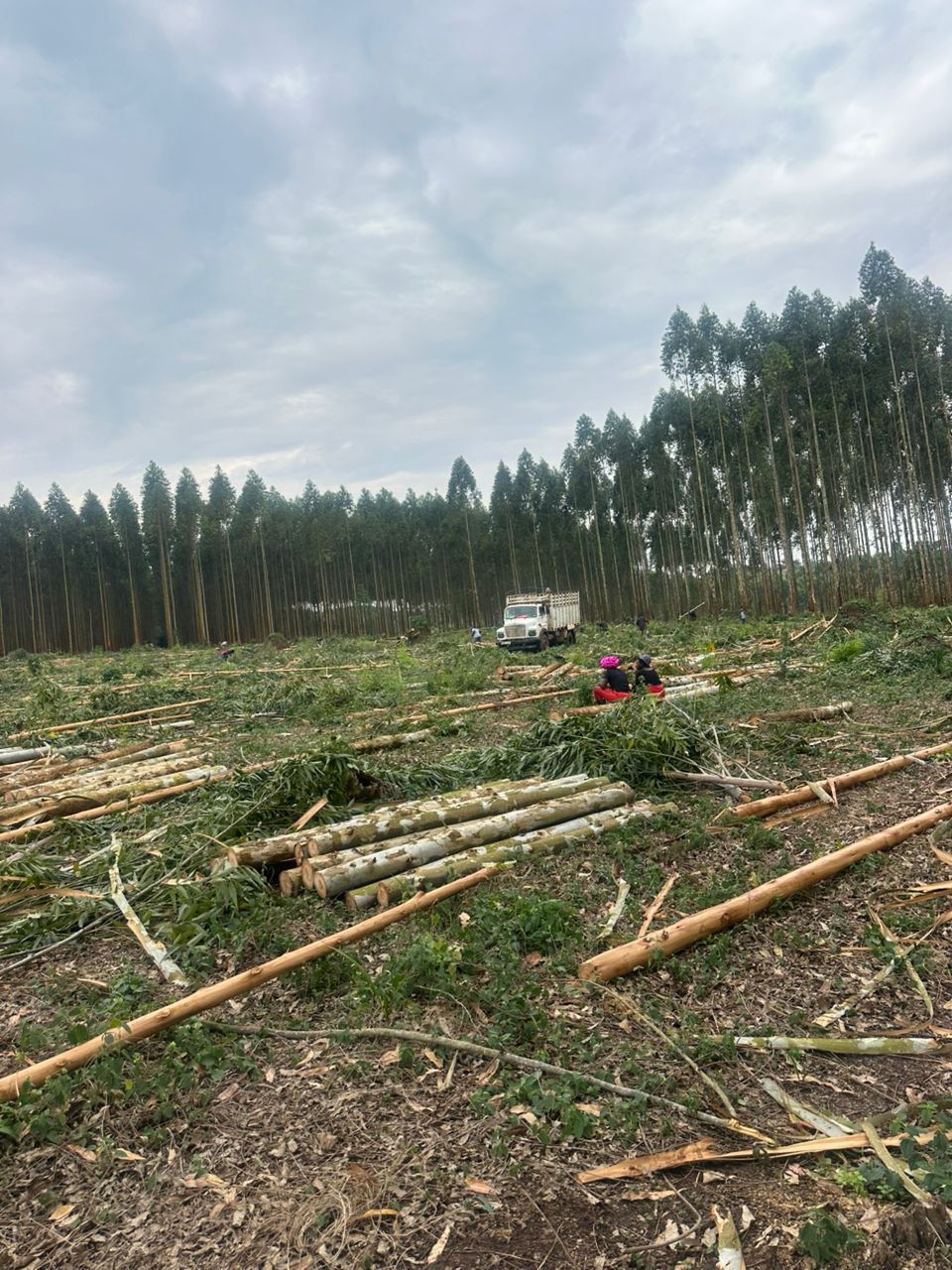
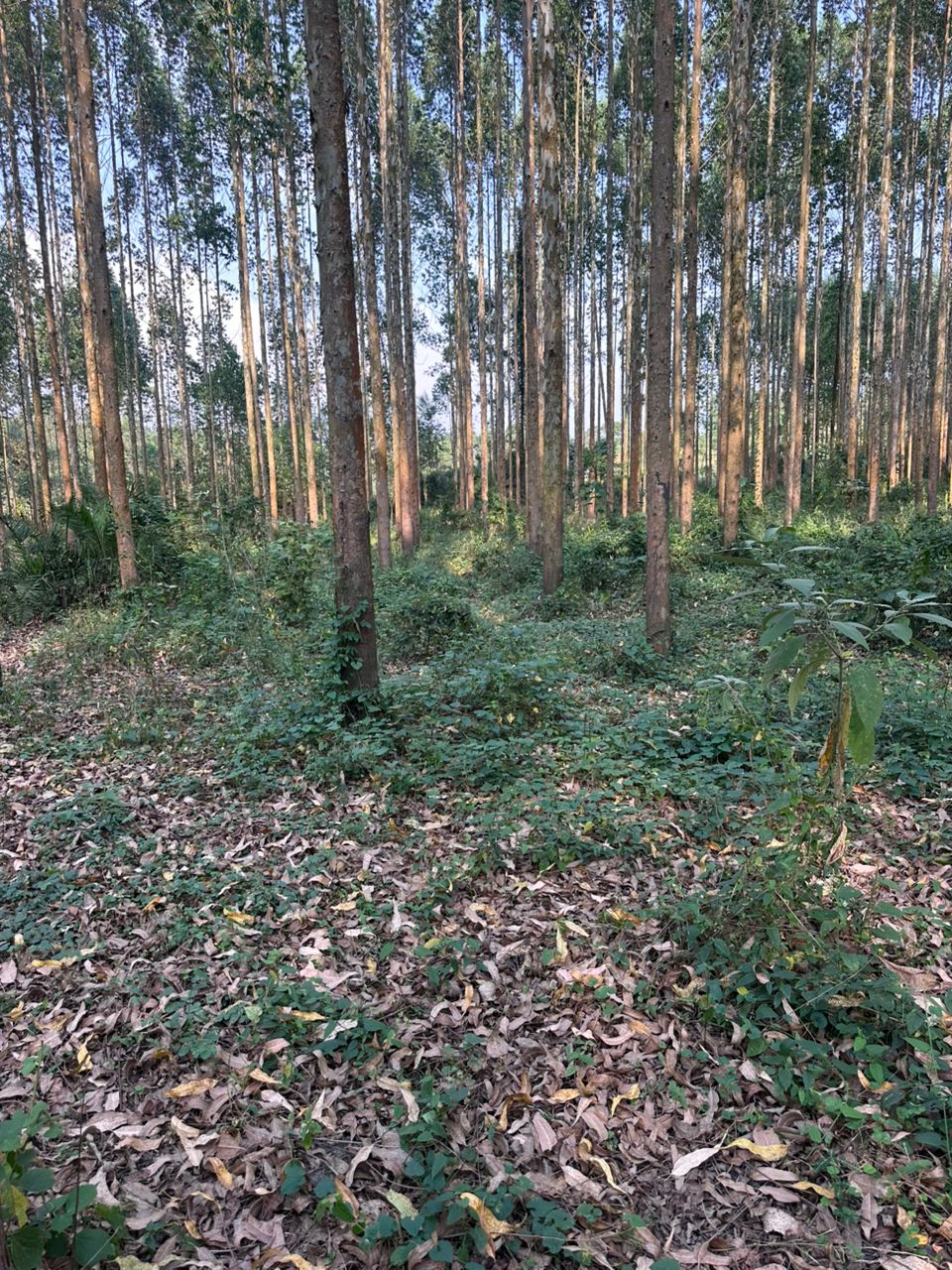
How Many Eucalyptus Trees Per Acre in Uganda? (Spacing Chart & Calculator)
At 2.5m × 2.5m — the most common commercial spacing in Uganda for the pole market — you can plant about 647 eucalyptus trees per acre, which is 1,600 trees per hectare.
At 3m × 3m it drops to about 450 trees per acre (1,111/ha). At 2m × 2m it rises to about 1,012 trees per acre (2,500/ha).
In practice, order 5–15% fewer seedlings than the chart figure to allow for firebreaks, access roads and boundary setbacks — then add about 5% back as replacement stock for beating up.
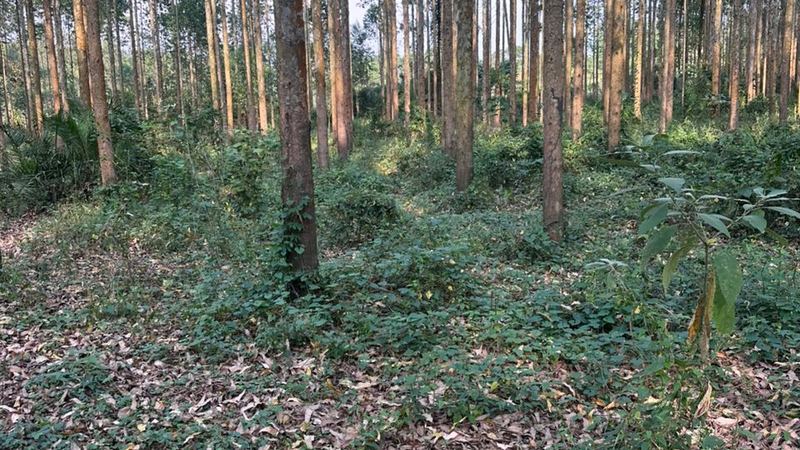
This is the single most common question we are asked by landowners in Kampala, Wakiso, Luwero and Mubende, and it usually arrives in the form: "I have four acres — how many eucalyptus seedlings should I buy?"
The arithmetic is simple. The judgement behind it is not. Spacing is the one decision that quietly determines what product you end up with in seven years, how much you spend on weeding, and whether your trees reach pole size or stay pencil-thin. This guide gives you the numbers first, then the reasoning.
The Quick Answer, By Plot Size
If you are standing in a nursery with your phone out, this is the table you need. Figures are at 2.5m × 2.5m, Uganda's default commercial pole spacing.
| Your land | Trees at 2.5m × 2.5m | Trees at 3m × 3m | Trees at 2m × 2m |
|---|---|---|---|
| 1 acre | 647 | 450 | 1,012 |
| 2 acres | 1,295 | 899 | 2,023 |
| 5 acres | 3,237 | 2,248 | 5,059 |
| 10 acres | 6,475 | 4,496 | 10,117 |
| 1 hectare (2.47 acres) | 1,600 | 1,111 | 2,500 |
| 10 hectares | 16,000 | 11,111 | 25,000 |
Full Eucalyptus Spacing Chart
Every spacing used commercially in Uganda, with the resulting stocking per acre and per hectare:
| Spacing | Trees per acre | Trees per hectare | Typical purpose |
|---|---|---|---|
| 1.5m × 1.5m | 1,799 | 4,444 | Very short-rotation firewood / biomass. Rarely advisable. |
| 2m × 2m | 1,012 | 2,500 | Firewood, charcoal, small poles, pulpwood |
| 2m × 2.5m | 809 | 2,000 | Small building poles, dense short rotation |
| 2m × 3m | 674 | 1,667 | Poles with easier access lines for weeding |
| 2.5m × 2.5m | 647 | 1,600 | Uganda's standard utility & building pole spacing |
| 2.5m × 3m | 540 | 1,333 | Larger poles, transmission poles |
| 3m × 3m | 450 | 1,111 | Large poles and small sawlogs |
| 3m × 4m | 337 | 833 | Sawlogs, agroforestry with intercropping |
| 4m × 4m | 253 | 625 | Sawn timber on long rotation, boundary and shade |
Figures are gross stocking on fully planted ground. See net planted area below before you place a seedling order.
Not sure how many acres you actually have? We measure it properly.
How to Calculate It Yourself
You do not need a chart. One acre is 4,047 square metres and one hectare is 10,000 square metres. Each tree occupies a rectangle equal to its spacing.
The formula
- Trees per acre = 4,047 ÷ (spacing A × spacing B), with spacing in metres
- Trees per hectare = 10,000 ÷ (spacing A × spacing B)
- Worked example at 2.5m × 2.5m: 2.5 × 2.5 = 6.25 m² per tree. 4,047 ÷ 6.25 = 647 trees per acre.
- Worked example at 3m × 3m: 3 × 3 = 9 m². 4,047 ÷ 9 = 450 trees per acre.
- To convert: 1 hectare = 2.471 acres; 1 acre = 0.405 hectares.
Note that this assumes a square or rectangular grid. On sloping land in western Uganda, contour planting follows the shape of the hill and the effective stocking usually comes out slightly lower — plan for about 5% fewer trees than the flat-ground figure.
Which Spacing Should You Choose?
Work backwards from the product you intend to sell. This is the part most growers get wrong, because they choose spacing based on what the neighbour did.
If you are growing utility and building poles (most Ugandan growers)
Use 2.5m × 2.5m. This is the workhorse spacing across central Uganda for good reason: it produces straight, evenly tapered stems at pole diameter within roughly five to eight years, the canopy closes fast enough to suppress grass and cut your weeding costs, and 647 stems per acre gives you enough volume to interest a buyer.
If you are growing firewood, charcoal or small poles
Go tighter — 2m × 2m at 1,012 trees per acre. You are selling weight and volume rather than individual stem quality, so more stems is straightforwardly better. Expect a shorter rotation and heavier competition-driven mortality, which is acceptable for this market.
If you are growing sawlogs or large transmission poles
Go wider — 3m × 3m to 4m × 4m. Fewer trees, each with more room to put on diameter. This requires patience and usually a thinning operation, but the price per cubic metre for sawlog-grade eucalyptus is substantially higher than pole prices.
If you want to intercrop in the early years
3m × 4m or wider leaves usable alleys for beans, maize or groundnuts for the first two to three seasons, which offsets establishment costs. This is a genuinely underused approach among Ugandan smallholders. The trade-off is a longer time to canopy closure and therefore more weeding.
"The most expensive mistake we see is a grower planting at 2m × 2m because it looked like more trees for the money, then discovering at year six that the stand is a thicket of thin stems no pole buyer wants. You cannot un-plant trees. You can only thin them, and thinning costs money you did not budget."
— Euca Eco Consults Field Team, Wakiso
Why You Order Fewer Seedlings Than the Chart Says
The chart gives gross stocking — trees on ground that is 100% plantable. Real land is not. Before ordering, deduct:
- Firebreaks: typically 3–6m around the block and sometimes internally. Non-negotiable in Uganda's dry seasons.
- Access and extraction roads: you will need them at harvest, and retrofitting them means felling trees you paid to grow.
- Boundary setbacks: keep trees back from neighbours' land, from roads, and from any watercourse or wetland margin.
- Unplantable ground: rock outcrops, gullies, waterlogged hollows, existing structures.
On a typical Ugandan smallholding this comes to 5–15% of gross area. So on 5 acres at 2.5m × 2.5m, the chart says 3,237 trees; a realistic planting figure is around 2,900–3,050.
Then add back roughly 5% as beating-up stock — replacement seedlings for the ones that fail in the first weeks. Filling gaps promptly is the difference between 80% and 95% final stocking, and it is far cheaper than living with the gaps.
Four Spacing Mistakes That Cost Money
- Planting tight to "maximise" the land. More stems is not more value if none of them reach saleable diameter. Density beyond what the site can carry converts into competition, not volume.
- Ignoring soil quality when setting density. A shallow, poor site cannot support 1,600 stems per hectare to pole size. On weaker ground, go wider — the trees you do grow will actually be sellable.
- No plan for access. A block planted wall-to-wall with no extraction route means a harvesting contractor either refuses the job or damages a swathe of standing trees getting in.
- Buying seedlings before measuring the land. Land in Uganda is very often sold on an assumed acreage that has never been verified. We regularly measure "five acres" that turns out to be 4.1. Order after measuring, not before.
What Ugandan Growers Actually Plant
Across the plantations we manage and assess in Wakiso, Mukono, Mpigi, Luwero, Nakaseke, Mubende and Masindi, the distribution looks roughly like this:
- 2.5m × 2.5m dominates — the majority of commercial pole plantings in central Uganda
- 3m × 3m is the second most common, chosen by growers targeting larger poles or planning to thin
- 2m × 2m appears mostly in fuelwood and charcoal blocks, and around institutions growing their own firewood
- 3m × 4m and wider is a minority choice, usually by growers intercropping or planting for sawn timber
Spacing also interacts with species and clone. Fast, vigorous clonal material such as GU and GC hybrids fills a site more quickly than seedling-grown E. grandis, so on good sites there is a case for slightly wider spacing with clones. Our guide to the best eucalyptus species and clones for Uganda covers which material suits which zone.
What To Do Next
Three steps, in this order:
- Measure the land. Not the title figure, not the seller's figure — a GPS walk of the actual boundary. See our GIS and acreage verification service.
- Decide the market before the spacing. Poles, firewood, or sawlogs? The spacing follows from that answer, never the other way round.
- Order seedlings against net area plus 5%. And inspect them at delivery — poor stock is the most common avoidable cause of first-year failure in Uganda.
If you would rather someone did all three properly, our tree planting service covers site assessment through to year-three aftercare, and we contract on survival rather than on seedlings in the ground.
Frequently Asked Questions
How many eucalyptus trees can be planted in one acre in Uganda?
About 647 trees per acre at the standard commercial spacing of 2.5m × 2.5m. At 3m × 3m it is about 450 trees per acre, and at 2m × 2m about 1,012 trees per acre.
Deduct 5–15% for firebreaks, access roads and boundary setbacks before ordering seedlings, then add roughly 5% as replacement stock for beating up.
How many eucalyptus trees per hectare?
1,600 trees per hectare at 2.5m × 2.5m; 1,111 at 3m × 3m; 2,500 at 2m × 2m; and 625 at 4m × 4m.
One hectare equals 2.471 acres, so hectare figures are always about 2.47 times the per-acre figure at the same spacing.
What is the best spacing for eucalyptus trees in Uganda?
For the utility and building pole market that most Ugandan growers sell into, 2.5m × 2.5m is the best general-purpose spacing. It closes canopy quickly, suppresses weeds, and produces straight stems at pole diameter in roughly five to eight years.
Choose 2m × 2m for firewood and charcoal, and 3m × 3m or wider for sawlogs, larger transmission poles, or where you want to intercrop in the early years.
How do I calculate trees per acre for any spacing?
Divide 4,047 (square metres in an acre) by the area each tree occupies. At 2.5m × 2.5m that is 6.25 m² per tree, so 4,047 ÷ 6.25 = 647 trees per acre.
For hectares, divide 10,000 by the same figure. At 2.5m × 2.5m: 10,000 ÷ 6.25 = 1,600 trees per hectare.
Does closer spacing mean more money?
No, and this is the most expensive misconception in Ugandan smallholder forestry. Beyond what a site can carry, extra stems compete with each other and you end up with a dense stand of thin poles that buyers discount heavily or refuse.
Value comes from stems reaching saleable diameter, not from stem count. On weaker soils in particular, wider spacing produces a more valuable crop.
How many eucalyptus trees per acre for firewood?
Firewood and charcoal blocks are usually planted at 2m × 2m, giving about 1,012 trees per acre (2,500 per hectare), sometimes tighter at 1.5m × 1.5m.
Because you are selling volume and weight rather than individual stem quality, higher density genuinely works for this market — unlike the pole market.
Should I use the same spacing for clonal eucalyptus?
Broadly yes, but clonal material such as GU and GC hybrids is more vigorous and uniform than seedling-grown stock, so on good sites there is a reasonable case for going slightly wider — 2.5m × 3m rather than 2.5m × 2.5m.
The gain is diameter at the same rotation age. On poor sites, stay with the standard spacing; the extra vigour will not materialise.
Want the Exact Number for Your Land?
Send us your location and plot size. We will confirm your true acreage, recommend a spacing for your target market, and tell you exactly how many seedlings to order.
Over a decade establishing, measuring and managing eucalyptus, pine and indigenous plantations across Uganda. Based in Wakiso, Kampala. Reviewed and updated August 12, 2026.