Eucalyptus Planting in Uganda: The Complete Guide to Spacing, Species and Yield
How many trees per acre? About 647 eucalyptus trees per acre at 2.5m × 2.5m spacing (1,600 per hectare). At 3m × 3m, about 450 per acre. Full spacing chart →
Which species? Eucalyptus grandis or a GU clone for central Uganda; E. camaldulensis or a GC clone for drier ground; E. globulus above ~1,800m. Species & clone guide →
When to plant? At the start of the long rains (February–March) or short rains (September–October) — after two to three weeks of consistent rainfall, never into dry soil.
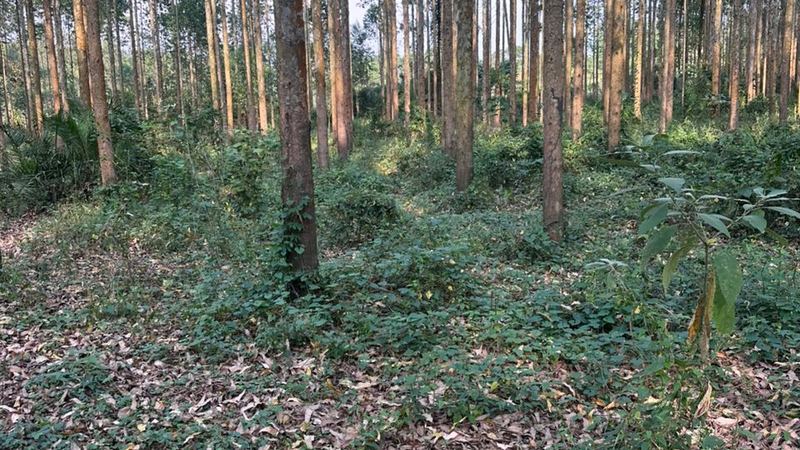
Uganda's warm, humid climate and fertile soils create near-perfect conditions for eucalyptus cultivation. With annual rainfall of 900–1,800mm across most of the country and temperatures that rarely fall below 15°C, eucalyptus trees can grow at extraordinary rates — often exceeding 8–12 cubic metres per hectare per year in well-managed stands.
Yet despite these favourable conditions, many landowners in Kampala and the Wakiso district fail to realise their plantations' full potential due to poor species selection, inadequate site preparation, and inconsistent management. This guide, drawing on over a decade of on-the-ground experience across Uganda, will walk you through every step of establishing a profitable eucalyptus plantation.
1. Understanding Uganda's Ecological Zones for Eucalyptus
Before selecting a site, it is essential to understand which ecological zone you are working in. Uganda has five main ecological zones, each with different implications for eucalyptus planting:
- Lake Victoria Crescent (Buganda Region): Including Kampala, Wakiso, and Masaka. Bimodal rainfall (March–May and October–December), highly fertile soils. Ideal for Eucalyptus grandis and E. saligna.
- Eastern Highlands: Mbale, Kapchorwa region. High altitude (1,500–4,000m), cooler temperatures. E. globulus and cold-tolerant E. maidenii perform well here.
- Western Highlands: Fort Portal, Kabale. Similar to eastern highlands — E. globulus is popular.
- Central Plateau: Luwero, Nakaseke. Slightly drier, well-suited to drought-tolerant E. camaldulensis.
- Northern Uganda: Gulu, Arua. Semi-arid conditions in some parts — E. camaldulensis is the recommended species.
"The single most important decision a eucalyptus farmer makes is matching the right species to the right site. Getting this wrong can cost years of growth and significant investment." — Euca Eco Consults Field Team
2. Site Selection and Assessment
A thorough site assessment before planting can make the difference between a thriving plantation and a failure. Key factors to evaluate include:
Soil Requirements
Eucalyptus trees are relatively adaptable but perform best in:
- Deep, well-drained loam or sandy loam soils (minimum 60cm depth)
- pH between 5.5 and 7.0
- Low to moderate clay content (excessive clay causes waterlogging)
- Avoid sites with hardpan or laterite layers within 50cm of the surface
In the Wakiso and Kampala regions, the dominant soil types are Ferralsols and Acrisols — both generally suitable for eucalyptus with appropriate management.
Topography and Drainage
Avoid valley bottoms and areas with seasonal flooding. Gentle slopes (2–15%) are ideal as they allow water drainage without excessive erosion. Steep slopes above 25% require terracing or contour planting to prevent soil loss.
Previous Land Use
Sites previously under natural forest or long-term cultivation typically have better soil structure and nutrient levels. Recently cleared swamp or wetland areas should be avoided — in addition to regulatory restrictions on wetland conversion in Uganda, such sites often lead to poor tree performance.
3. Recommended Eucalyptus Species for Uganda
There are over 700 eucalyptus species, but only a handful are commercially relevant in Uganda's conditions:
- Eucalyptus grandis: The most widely planted species in Central Uganda (Wakiso, Kampala, Mubende). Fast-growing, excellent for timber poles and pulpwood. Can reach 20–30m in 7 years.
- Eucalyptus saligna: Similar to E. grandis, slightly more drought-tolerant. Good for mixed elevations.
- Eucalyptus camaldulensis: Best for drier regions (Northern and parts of Eastern Uganda). More drought-resilient, commonly used for fuelwood and charcoal.
- Eucalyptus globulus: Best for high-altitude Uganda (above 1,500m). High-quality timber but slower growth at lower elevations.
- Eucalyptus grandis × urophylla hybrids (GU): Increasingly available in Uganda through improved seedling programmes. Combines the fast growth of E. grandis with the adaptability of E. urophylla. Clone codes such as GU7 and GU8 identify specific selected individuals, not quality grades.
Eucalyptus is known in Luganda as kalitunsi — a general term covering all species, so always ask a nursery which species or clone they are actually selling. For a full comparison of species and clones by ecological zone, including how to avoid mislabelled clonal stock, see our guide to the best eucalyptus species and clones for Uganda.
4. Land Preparation
Proper land preparation is critical for early establishment success. The key steps are:
Clearing
Remove existing vegetation completely. For sites with stumps, either remove them or treat with herbicide (glyphosate at recommended rates) to prevent coppicing competition. In Uganda, burning cleared material is common but should be done carefully to avoid nutrient loss — incorporate material as mulch where possible.
Sub-soiling
On compacted soils, sub-soiling to 45–60cm breaks up hardpan layers and significantly improves root penetration and early growth. In the Wakiso region, this step is often skipped, leading to stunted growth in year 2–3.
Planting Holes
Dig holes of at least 30cm × 30cm × 30cm. Larger holes (45cm × 45cm × 45cm) are recommended on poorer soils. Mix topsoil with compost and a slow-release phosphate fertiliser (100g of triple superphosphate per hole is a standard recommendation for Uganda's soils).
5. Spacing & Trees Per Acre: Calculator
Spacing depends on your primary objective. Most Ugandan landowners think in acres, so both units are given here:
| Spacing | Trees per acre | Trees per hectare | Best for |
|---|---|---|---|
| 2m × 2m | 1,012 | 2,500 | Firewood, charcoal, pulpwood, biomass |
| 2m × 3m | 674 | 1,667 | Poles with easier weeding access lines |
| 2.5m × 2.5m | 647 | 1,600 | Utility & building poles — Uganda's standard |
| 2.5m × 3m | 540 | 1,333 | Larger poles, transmission poles |
| 3m × 3m | 450 | 1,111 | Large poles and small sawlogs |
| 3m × 4m | 337 | 833 | Sawlogs, agroforestry with intercropping |
| 4m × 4m | 253 | 625 | Sawn timber on long rotation, with thinning |
For most smallholder farmers in the Kampala and Wakiso areas targeting the pole market, 2.5m × 2.5m (647 trees per acre) or 3m × 2.5m is optimal.
Two practical adjustments before you order seedlings. First, deduct 5–15% of gross area for firebreaks, extraction roads and boundary setbacks — the table gives stocking on fully plantable ground and real land never is. Second, add back roughly 5% as replacement stock for beating up in the first weeks.
To work out any spacing yourself: trees per acre = 4,047 ÷ (spacing A × spacing B in metres). Our full guide to eucalyptus trees per acre in Uganda covers the calculation, plot-size tables and how to choose spacing for your target market.
We measure your land properly, so you order the right number.
6. Planting Season
In Uganda's bimodal rainfall zones (including Kampala and Wakiso), plant at the start of the long rains (February–March) or the short rains (September–October). Planting into dry soil significantly increases mortality — wait for at least 2–3 weeks of consistent rainfall before planting.
7. Post-Planting Management
Year 1: Establishment Phase
- Carry out 2–3 weeding rounds to reduce competition in the first 12 months
- Apply nitrogen fertiliser (50g urea per tree) at 3 months if growth is slow
- Replace dead seedlings within the first 8 weeks (target: ≥95% survival rate)
Years 2–4: Growth Phase
- Prune lower branches to 50% of crown height at year 2 (improves timber quality and reduces fire risk)
- Apply potassium and phosphorus fertiliser on poor soils
- Monitor for pests — in Uganda, Leptocybe invasa (eucalyptus gall wasp) is a significant threat requiring proactive monitoring and resistant variety selection
Years 5–7: Pre-Harvest
- Conduct a stand volume assessment to confirm harvest readiness
- Plan harvesting and log-out routes in advance
- Consider pole market vs. charcoal vs. sawn timber pricing before harvest
8. Expected Returns in Uganda
Based on our experience managing plantations across Uganda, indicative returns for a well-managed E. grandis plantation in Central Uganda at 3m × 2.5m spacing are:
- Year 5–7 first harvest: 150–250 utility poles per hectare (market price UGX 15,000–50,000 per pole depending on length and quality)
- Coppice regrowth: Second and third rotations from the same stools, significantly reducing establishment costs
- Carbon value: Increasingly, Ugandan plantations are generating carbon credits through verified carbon standards
Conclusion: Professional Guidance Makes the Difference
Establishing a eucalyptus plantation in Uganda represents one of the most compelling land-use investments available to Ugandan landowners and investors — but the details matter enormously. Species selection, soil assessment, proper spacing, and consistent management are all critical success factors that are easily overlooked without professional guidance.
At Euca Eco Consults Limited, we offer end-to-end plantation establishment and management services from our base in Wakiso, Kampala. Whether you're planting 2 acres or 200 hectares, our team of experienced foresters and environmental scientists will develop a customised plantation plan that maximises your returns while meeting sustainability standards.
Frequently Asked Questions
How many eucalyptus trees can be planted in an acre in Uganda?
About 647 eucalyptus trees per acre at the standard commercial spacing of 2.5m × 2.5m, which is 1,600 trees per hectare. At 3m × 3m it is about 450 per acre (1,111/ha); at 2m × 2m about 1,012 per acre (2,500/ha).
Deduct 5–15% for firebreaks, access roads and boundary setbacks before ordering, then add about 5% as replacement stock. See the full spacing chart and plot-size tables.
What is the best eucalyptus species to plant in Uganda?
For most of central Uganda — Kampala, Wakiso, Mukono, Luwero, Mubende — Eucalyptus grandis or a GU clone is the best choice for commercial poles. On drier or poorer ground, use E. camaldulensis or a GC clone. Above roughly 1,800m (Kabale, Kapchorwa), use E. globulus.
Our species and clone guide breaks this down by ecological zone and district.
What is the best spacing for eucalyptus trees in Uganda?
2.5m × 2.5m for the utility and building pole market that most Ugandan growers sell into. It closes canopy quickly, suppresses weeds and produces straight stems at pole diameter in roughly five to eight years.
Use 2m × 2m for firewood and charcoal, and 3m × 3m or wider for sawlogs or where you want to intercrop in the early years.
When should you plant eucalyptus in Uganda?
In the bimodal rainfall zones covering Kampala, Wakiso and most of central and southern Uganda, plant at the start of the long rains (February–March) or the short rains (September–October).
Wait for two to three weeks of consistent rainfall before planting. Planting into dry soil to meet a schedule is the most expensive shortcut in Ugandan forestry.
How long does eucalyptus take to mature in Uganda?
On a good site with proper establishment and weeding, E. grandis and GU clones typically reach utility pole dimensions in roughly five to eight years.
Growth is highly site-dependent. The same species on a shallow, unweeded or waterlogged site can take considerably longer and still not produce saleable stems — which is why site assessment matters more than species choice.
What is eucalyptus called in Luganda?
Eucalyptus is called kalitunsi in Luganda (also written kalitusi or kalitoonsi). The name covers eucalyptus generally rather than any particular species, so a nursery selling "kalitunsi" could be selling E. grandis, E. camaldulensis or a clone. Always ask which.
Does eucalyptus really use too much water?
Eucalyptus is fast-growing and fast growth requires water — that much is simply true. The problem in Uganda has been siting rather than the tree itself: eucalyptus planted in wetlands, on riverbanks and in valley bottoms causes real hydrological and regulatory problems.
Planted on appropriate upland sites with proper setbacks from watercourses and wetland margins, it is a legitimate and productive land use. Setbacks are a legal requirement in Uganda, not merely good practice — check before planting near any watercourse.
Ready to Plant? Start With a Free Site Assessment
Species, spacing and planting season are the three decisions that determine most of your outcome — and all three depend on your site. We will walk it, measure it and tell you honestly what will work. The first consultation costs nothing.
Related Guides
10+ years of eucalyptus forestry and environmental consultancy experience across Uganda. Based in Wakiso, Kampala.