Eucalyptus Growth Rate: How Fast Does It Really Grow?
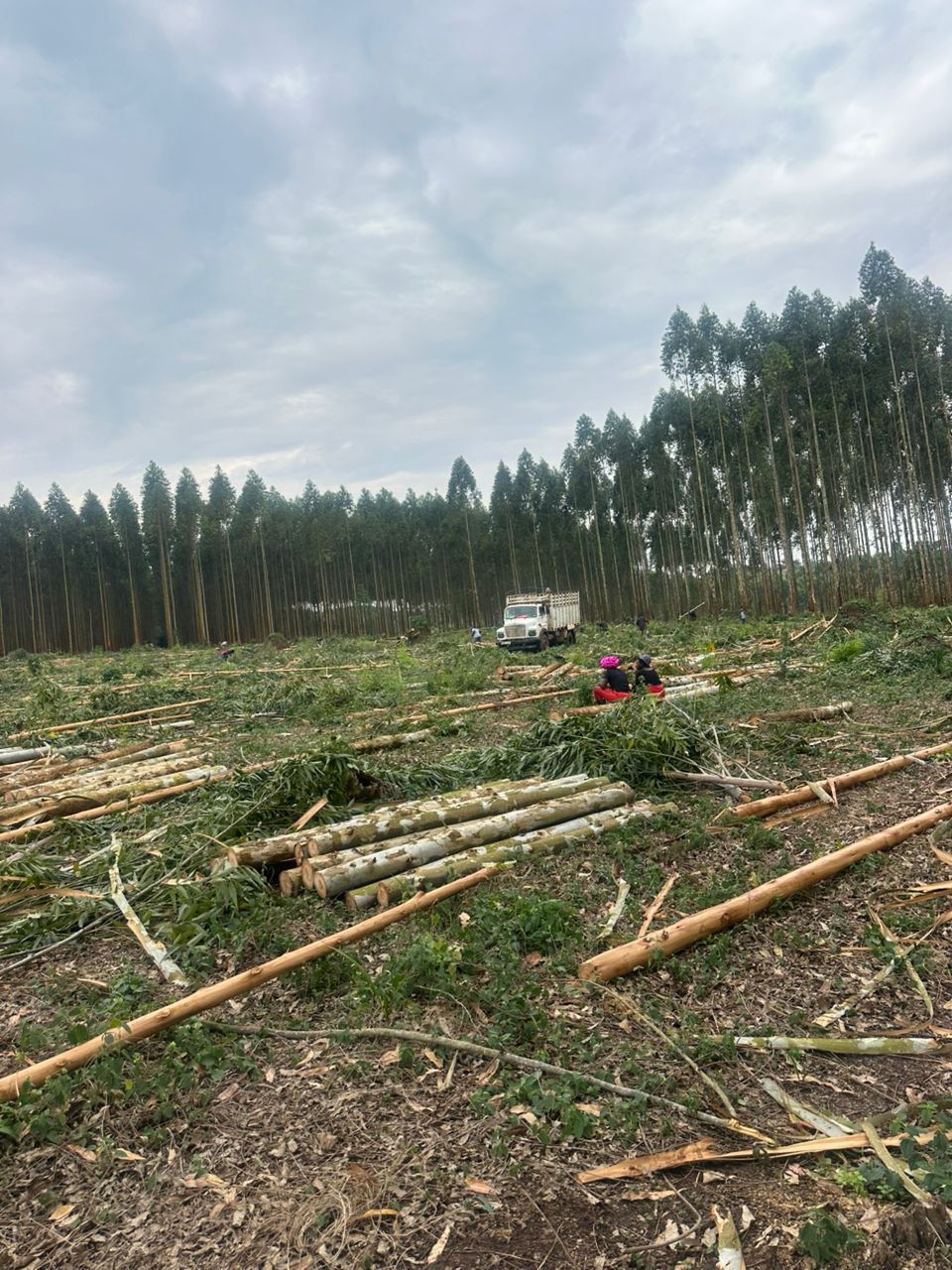
Well-managed eucalyptus on a good site commonly achieves 20–30 m³ per hectare per year. Exceptional sites with matched clonal material exceed 30. Average smallholder plantations with partial weeding sit nearer 8–15. Poor sites with mismatched species fall below 5.
That is a six-fold range for the same genus — which tells you that growth rate is mostly not a property of the tree.
What Actually Controls Growth
| Factor | Influence | Controllable? |
|---|---|---|
| Water availability | Largest single factor. Rainfall, distribution and soil water-holding capacity | Only by site choice |
| Soil depth & drainage | Very large. Shallow or waterlogged ground caps growth permanently | Only by site choice |
| First-year weed control | Largest controllable factor. Competition in year one costs growth you never recover | Yes |
| Genetics | Significant on a matched site; can be negative on a mismatched one | Yes, at planting |
| Stocking | Affects per-tree growth strongly, per-hectare growth less | Yes, at planting |
| Nutrition | Moderate; matters most on depleted soils | Yes |
| Pests | Can be severe — gall wasp on susceptible material | Partly, by clone choice |
| Temperature / altitude | Determines which species will perform at all | Only by species choice |
Read the right-hand column. The two biggest factors are fixed by where your land is. The biggest one you control is weeding in year one — not genetics, and not fertiliser.
Growth by Species
| Species | Relative growth | Conditions needed |
|---|---|---|
| E. grandis | Very fast | Deep fertile soil, reliable high rainfall, warm |
| GU clones (grandis × urophylla) | Very fast, more uniform | Good to moderate sites; broader tolerance than pure grandis |
| E. saligna | Fast | Similar to grandis, slightly more drought tolerant |
| GC clones (grandis × camaldulensis) | Fast on drier sites | Where grandis would struggle |
| E. camaldulensis | Moderate | Tolerates drought and poor soil — grows where others fail |
| E. globulus | Fast at altitude, poor low down | Cool highlands above roughly 1,800–2,000m |
| E. urophylla | Fast, humid tropics | Warm and humid; mostly used as a hybrid parent |
Note that "fastest" is conditional. E. grandis is faster than camaldulensis on a good site and slower on a dry one, because it will not perform there at all.
Height Growth vs Volume Growth
These are different questions and are often confused.
- Height growth is fastest in the early years. Several metres a year is achievable on a good site, and this is what impresses people visually.
- Volume growth peaks later, once the canopy has closed and the stand is putting on diameter as well as height.
- Diameter growth is what determines your product. A tall thin stem is not a pole.
- A stand that looks spectacular at year two can still disappoint at year seven if it was planted too tight — height without diameter.
Want to know what your site will actually achieve? That needs soil pits.
Coppice Often Grows Faster
After the first harvest, eucalyptus regrows from the stump. That coppice regrowth typically establishes faster than the original planting, because the root system is already there and does not have to be built.
- Second rotations are often shorter than the first for the same product.
- No establishment cost — no clearing, pitting, seedlings or planting labour.
- Shoots must be thinned to one or two strong stems per stump, or you grow a bush rather than a tree.
- Vigour declines eventually; most growers get two or three good rotations before replanting.
Reading Growth Claims Sceptically
Four questions to ask about any growth figure
- On what site? A figure without rainfall, soil depth and altitude is not a figure.
- Under what management? Weeded how many times in year one? Fertilised?
- Measured or claimed? Systematic plots, or the best corner of the block?
- Height or volume? Height growth is the impressive number; volume is the one that sells.
Nursery and clone marketing frequently quotes the top of the range achieved on an excellent trial site under full management. Your ordinary block will not replicate it, and that is not the clone's fault.
Frequently Asked Questions
How fast does eucalyptus grow?
Well-managed eucalyptus on a good site commonly achieves 20–30 cubic metres per hectare per year, with exceptional sites exceeding 30. Average smallholder plantations run nearer 8–15.
That six-fold range for the same genus tells you growth rate is mostly determined by site and management rather than by the tree.
Which eucalyptus grows fastest?
On good, deep, well-watered sites, E. grandis and GU clones. But 'fastest' is conditional — on dry or poor ground E. camaldulensis outgrows grandis simply because grandis will not perform there.
At altitude above roughly 1,800–2,000m, E. globulus outperforms both.
How tall does eucalyptus grow in a year?
Height growth of several metres a year is achievable on a good site in the early years, and it is the number that impresses people visually.
But height is not the product. Diameter determines whether you have a pole or a stick, and a stand planted too tight can be tall and worthless.
What is the single biggest thing I can do to improve growth?
Weed properly in the first year. Grass competition in the first twelve months costs growth that is never recovered, and no amount of genetics or fertiliser compensates for it.
The two larger factors — water availability and soil depth — are fixed by where your land is. Weeding is the biggest one you control.
Does coppice regrowth grow faster than the original planting?
Usually yes, at least in establishment, because the root system already exists and does not have to be rebuilt. Second rotations are often shorter than the first for the same product.
You must thin the shoots to one or two strong stems per stump, and vigour declines after two or three rotations.
Why did my eucalyptus grow slower than the nursery said?
Marketing figures usually quote the top of the range, achieved on an excellent trial site under full management with timely weeding.
Ask any growth claim four questions: on what site, under what management, measured how, and is it height or volume.
What Will Your Site Actually Grow?
Growth is mostly a property of the land, not the tree. Three soil pits and a rainfall check give you a realistic figure.
Over a decade establishing, measuring and managing eucalyptus, pine and indigenous plantations across Uganda. Based in Wakiso, Kampala. Reviewed and updated September 6, 2026.
Keep going
These apply the same way in any country.